Friday, December 12, 2008
Exam Review Discussion Post
Please comments on this post for addressing your queries or thoughts about Geometry before the exam.

Friday, December 5, 2008
Wednesday, December 3, 2008
Homework due 12/05/08
Read pages 151-153 of the text book and take notes on the reading. Make sure to try and understand the theorems and corollaries discussed.
Tuesday, December 2, 2008
Homework due 12/02/08
Prove that if the sides of a polygon are extended, the sum of the exterior angles formed is 360 degrees.
(Please do not use your text book or other websites to try and find an answer to this question. You may use the blog, of course, and, hence, each other as a resource.)
(Please do not use your text book or other websites to try and find an answer to this question. You may use the blog, of course, and, hence, each other as a resource.)
Sunday, November 23, 2008
Thursday, November 20, 2008
Homework due 11/21/08
Read pages 129 and 130 of your text book. Our discussion of polygons on Tuesday should shed some light on much of the reading, or vice-versa.
Friday, November 14, 2008
Test on Wednesday, 11/19/08
Your next test will be on Wednesday and it will assess every topic we have covered so far in the term. By now you must be realizing that much of what is covered is continuously recalled in every new topic of study. So, the task of taking a test that is cumulative is actually not as daunting as it may sound.
Thursday, November 13, 2008
Tuesday, November 11, 2008
Thursday, November 6, 2008
Homework due 11/7/08
By completing the proof below you will be proving the following theorem:
So, given that AB and CD are line segments crossed by a transversal at P and Q and that angles APQ = PQD, prove that AB is parallel to CD.

If two lines and a transversal form a pair of equal alternate-interior angles, then the lines are parallel.
So, given that AB and CD are line segments crossed by a transversal at P and Q and that angles APQ = PQD
Sunday, November 2, 2008
Quiz on Friday, 11/7/08
You will have a quiz on what we have covered in Chapter 6 on perpendicular lines and planes.


Thursday, October 30, 2008
Wednesday, October 29, 2008
Homework due 10/31/08
Focus on the Challenge Problem we started in class today and document all the relationships you can find.


Friday, October 24, 2008
Homework due 10/28/08
Do problems 1-4, 8, and 14 on pages 108-109 and then problem 3 from the second set of exercises on page 109.
Thursday, October 23, 2008
Homework due 10/24/08
Do exercises 1-8 on page 103 of the textbook. Then, you have a drawing assignment as follows:
Draw a right triangle contained in a horizontal plane and a vertical right triangle where one of its legs is the same as the hypotenuse of the horizontal right triangle. Try these drawings in both orthographic and perspective formats.

Draw a right triangle contained in a horizontal plane and a vertical right triangle where one of its legs is the same as the hypotenuse of the horizontal right triangle. Try these drawings in both orthographic and perspective formats.

Monday, October 20, 2008
Homework due 10/21/08
Do exercises 4, 6, and 12 on page 100 and then read pages 101-103. For the reading, make sure to try some of the suggested drawings in your homework journal to see if you understand what they mean. If you don't quite get it, don't worry too much because Tuesday will be one big drawing lesson anyway.
Tuesday, October 7, 2008
Test on 10/15/08
You will have a test on all that we have covered so far in the term up until and including the material covered on Friday, 10/10/08.
Friday, October 3, 2008
Homework due 10/06/08
Page 81; (Misc. Exercises) # 1, 2, 4 & 5.
Page 82; (Chapter Review) #1-3
Answers will be posted over the weekend.
Page 82; (Chapter Review) #1-3
Answers will be posted over the weekend.
Thursday, October 2, 2008
Let's be 'Constructive'!
Complete the construction assignment for Friday. You can use this blog as a communication portal for seeking help. Remember, no text books for the assignment.
Wednesday, October 1, 2008
Homework due 10/01/08
Read pages 74-77 of the text book and take notes on the reading in your homework journals. Make sure you understand the proof on page 77, paying close attention to the format of it.
Monday, September 29, 2008
Quiz on 10/03/08
Your quiz will cover everything on the congruence of triangles that we have learned up until and including Wednesday's class on 10/01/08.
Saturday, September 27, 2008
Thursday, September 25, 2008
Homework due 9/26/08
Revise questions 1-6 that we finished in class and then prove the isosceles triangle theorem from the handout given in class. Please do not open your text books for the proof. A copy of the handout is attached to a message in the conference folder.
Friday, September 19, 2008
Test on 9/22/08
You test will be on everything we have covered up until the study of triangles, but not including triangles. Make sure to re-read the pages from the text that have been assigned so far, keeping in mind all the definitions and postulates we have discussed. You do not need to memorize theorems for proofs as I will provide you with important theorems and definitions that will apply to the proofs on the test.
Thursday, September 18, 2008
Homework due 9/19/08
Finish the proof for the construction of the square that you started in class today and then read pages 60-64 of your textbook. Make sure to take notes in your homework journal. Again, don't worry about not fully understanding the proofs of a theorem or so in the reading; we'll tackle it later.
Monday, September 15, 2008
Homework due 9/16/08
Try exercises 14, 16, and 18 on page 54 of the textbook. Keep refining your proof writing based on the class discussions today. Then read pages 57 and 58.
Saturday, September 13, 2008
Homework due 9/15/08
Read Pages 44-45 & 47-49. Then do problems on pages 52-53; #1, 3, 5, 6, 8, & 12. Remember to write out the proofs in well formed sentences and in as much detail as possible. Some things may seem obvious to you but may still need to be stated for the monument of logical arguments to stand.
Wednesday, September 10, 2008
Number vs. Magnitude
In light of the various questions about the distinction between number and magnitude, the following is an excerpt from Chapter 2 of Victor J. Katz's book:
___________________________________________________________
A History of Mathematics: An Introduction (2nd Ed.),
1998, Addison-Wesley Educational Publishers, Page 56.
___________________________________________________________
Victor J. Katz,Another of Aristotle's contributions was the introduction into mathematics of the distinction between number and magnitude. The Pythagoreans had insisted that all was number, but Aristotle rejected that idea. Although he placed number and magnitude in a single category, "quantity," he divided this category into two classes, the discrete (number) and the continuous (magnitude). As examples of the latter, he cited lines, surfaces, volumes, and time. The primary distinction between these two classes is that magnitude is "that which is divisible into divisibles that are infinitely divisible," while the basis of number is the indivisble unit. Thus magnitudes cannot be composed of indivisible elements, while numbers inevitably are.
Aristotle further clarified this idea in his definition of "in succession" and "continuous." Things are in succession if there is nothing of their own kind intermediate between them. For example, the numbers 3 and 4 are in succession. Things are continous when they touch and when "the touching limits of each become one and the same." Line segments are therefore continuous if they share an endpoint. Points cannot make up a line, because they would have to be in contact and share a limit. Since points have no parts, this is impossible. It is also impossible for points on a line to be in succession, that is, for there to be a "next point." For between two points on a line is a line segment, and one can always find a point on that segment.
Today, a line segment is considered to be composed of an infinite collection of points, but to Aristotle this would make no sense. He did not concieve of a completed or actual infinity. Although he used the term "infinity," he only considered it as potential. For example, one can bisect a continuous magnitude as often as one wishes, and one can count these bisections. But in niether case does one ever come to an end. Furthermore, mathematicians really do not need infinite quantities such as infinite straight lines. They only need to postulate the existence of, for example, arbitrarily long straight lines.
A History of Mathematics: An Introduction (2nd Ed.),
1998, Addison-Wesley Educational Publishers, Page 56.
Monday, September 8, 2008
Homework due 9/10/08
Read the excerpt on Euclid from the book A History of Mathematics: An Introduction, by Victor J. Katz and take good notes on the reading. Then comment on this post and pose questions that you have on the reading. You may also answer each others' questions using the blog. What I am hoping for is some meaningful dialogue about the reading before our block period class on Wednesday.
Quiz on 9/9/08
This quiz shall assess all that we have covered so far, including methods of reasoning and our assumptions upon which certain postulates are formed. You should know key definitions we have agreed upon so far and focus on what these definitions rely upon. We have covered several exercises from the text and they can serve as a great reviewing tool.
Wednesday, September 3, 2008
Homework due 9/8/08
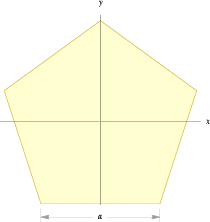
Determine a straightedge and compass construction of a regular pentagon. Start by playing with line and circle constructions and document your work. If after various attempts you cannot figure out a construction that can be justified then you may turn to other resources. Research Euclid’s methods and see if you can find something that you can reconstruct and understand. Discuss your explorations with your classmates by commenting on this post. You will present your explorations and your findings in class on Monday.


Subscribe to:
Comments (Atom)


