Monday, September 29, 2008
Quiz on 10/03/08
Your quiz will cover everything on the congruence of triangles that we have learned up until and including Wednesday's class on 10/01/08.

Saturday, September 27, 2008
Thursday, September 25, 2008
Homework due 9/26/08
Revise questions 1-6 that we finished in class and then prove the isosceles triangle theorem from the handout given in class. Please do not open your text books for the proof. A copy of the handout is attached to a message in the conference folder.
Friday, September 19, 2008
Test on 9/22/08
You test will be on everything we have covered up until the study of triangles, but not including triangles. Make sure to re-read the pages from the text that have been assigned so far, keeping in mind all the definitions and postulates we have discussed. You do not need to memorize theorems for proofs as I will provide you with important theorems and definitions that will apply to the proofs on the test.
Thursday, September 18, 2008
Homework due 9/19/08
Finish the proof for the construction of the square that you started in class today and then read pages 60-64 of your textbook. Make sure to take notes in your homework journal. Again, don't worry about not fully understanding the proofs of a theorem or so in the reading; we'll tackle it later.
Monday, September 15, 2008
Homework due 9/16/08
Try exercises 14, 16, and 18 on page 54 of the textbook. Keep refining your proof writing based on the class discussions today. Then read pages 57 and 58.
Saturday, September 13, 2008
Homework due 9/15/08
Read Pages 44-45 & 47-49. Then do problems on pages 52-53; #1, 3, 5, 6, 8, & 12. Remember to write out the proofs in well formed sentences and in as much detail as possible. Some things may seem obvious to you but may still need to be stated for the monument of logical arguments to stand.
Wednesday, September 10, 2008
Number vs. Magnitude
In light of the various questions about the distinction between number and magnitude, the following is an excerpt from Chapter 2 of Victor J. Katz's book:
___________________________________________________________
A History of Mathematics: An Introduction (2nd Ed.),
1998, Addison-Wesley Educational Publishers, Page 56.
___________________________________________________________
Victor J. Katz,Another of Aristotle's contributions was the introduction into mathematics of the distinction between number and magnitude. The Pythagoreans had insisted that all was number, but Aristotle rejected that idea. Although he placed number and magnitude in a single category, "quantity," he divided this category into two classes, the discrete (number) and the continuous (magnitude). As examples of the latter, he cited lines, surfaces, volumes, and time. The primary distinction between these two classes is that magnitude is "that which is divisible into divisibles that are infinitely divisible," while the basis of number is the indivisble unit. Thus magnitudes cannot be composed of indivisible elements, while numbers inevitably are.
Aristotle further clarified this idea in his definition of "in succession" and "continuous." Things are in succession if there is nothing of their own kind intermediate between them. For example, the numbers 3 and 4 are in succession. Things are continous when they touch and when "the touching limits of each become one and the same." Line segments are therefore continuous if they share an endpoint. Points cannot make up a line, because they would have to be in contact and share a limit. Since points have no parts, this is impossible. It is also impossible for points on a line to be in succession, that is, for there to be a "next point." For between two points on a line is a line segment, and one can always find a point on that segment.
Today, a line segment is considered to be composed of an infinite collection of points, but to Aristotle this would make no sense. He did not concieve of a completed or actual infinity. Although he used the term "infinity," he only considered it as potential. For example, one can bisect a continuous magnitude as often as one wishes, and one can count these bisections. But in niether case does one ever come to an end. Furthermore, mathematicians really do not need infinite quantities such as infinite straight lines. They only need to postulate the existence of, for example, arbitrarily long straight lines.
A History of Mathematics: An Introduction (2nd Ed.),
1998, Addison-Wesley Educational Publishers, Page 56.
Monday, September 8, 2008
Homework due 9/10/08
Read the excerpt on Euclid from the book A History of Mathematics: An Introduction, by Victor J. Katz and take good notes on the reading. Then comment on this post and pose questions that you have on the reading. You may also answer each others' questions using the blog. What I am hoping for is some meaningful dialogue about the reading before our block period class on Wednesday.
Quiz on 9/9/08
This quiz shall assess all that we have covered so far, including methods of reasoning and our assumptions upon which certain postulates are formed. You should know key definitions we have agreed upon so far and focus on what these definitions rely upon. We have covered several exercises from the text and they can serve as a great reviewing tool.
Wednesday, September 3, 2008
Homework due 9/8/08
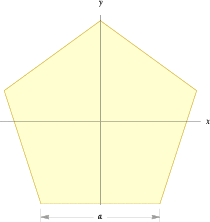
Determine a straightedge and compass construction of a regular pentagon. Start by playing with line and circle constructions and document your work. If after various attempts you cannot figure out a construction that can be justified then you may turn to other resources. Research Euclid’s methods and see if you can find something that you can reconstruct and understand. Discuss your explorations with your classmates by commenting on this post. You will present your explorations and your findings in class on Monday.


Subscribe to:
Comments (Atom)


