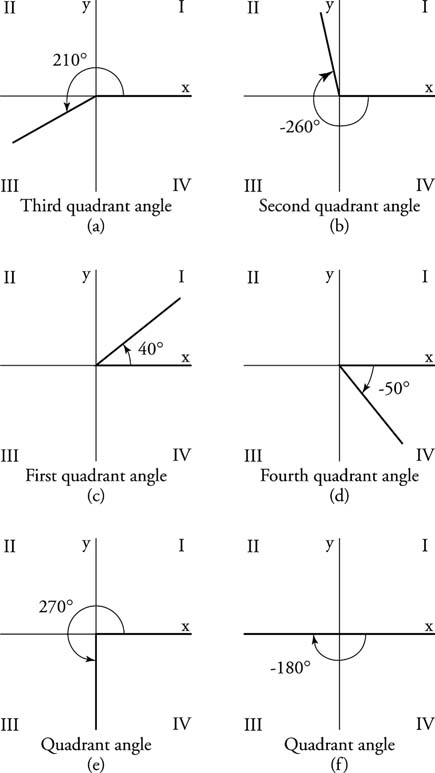
Folks, your assignment for Friday is the handout I gave you in class. If you misplace it or forget it in school you should download it from the AGT conference folder in First Class. If some of you felt overwhelmed by today's class then I suggest looking over the notes and the whole deal with radian measure, degree measure, negative angles and what they mean and what we mean by angles larger than 360 degrees or 2Pi radians. Click here for an image that can help you with the questions about quadrants.
Below are some things to remember for the homework assignment:
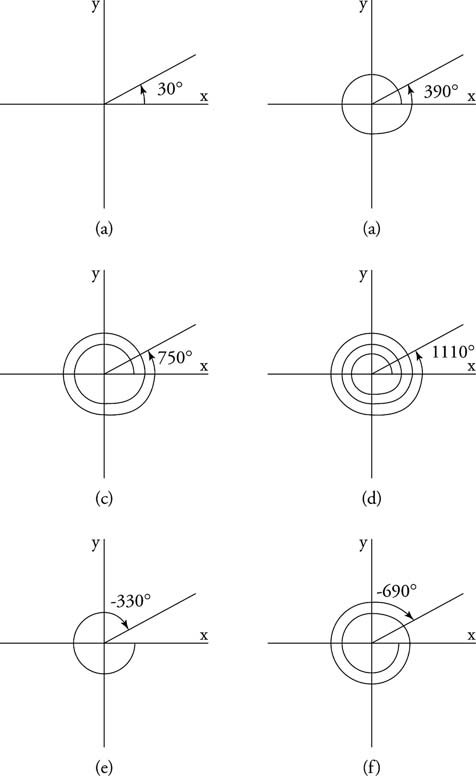
In question 1 you should refer to your unit circles and/or your trig tables. Remember that the sign (- or +) for sines, cosines and tangents becomes very important here. If angles are negative, then figure out which positive angles they are "co-terminal" with to figure out the sines, cosines and tangents. If the angles are larger then 360 degrees or much smaller than 360 degrees (such as - 405 degrees) then do the same, i.e. figure out which angle it is co-terminal with and then find the corresponding function values from your unit circle. Below is a link to an image that I think will help you understand what is meant by these new types of angles we are witnessing:
http://media.wiley.com/Lux/65/10665.nfg003.jpg
In question 2 you should note that I have asked for two solutions to the equations. In other words, there are two angles between 0 and 360 degrees that correspond to those particular lengths of lines that each equation depicts. Look at your unit circles and this will make more sense. Make sure to give the angles in both radians and degrees as the question demands. Remember, no calculators here as well.
Question 3 should be a straightforward question that you need no special hints for.
Thursday, April 30, 2009

Monday, April 27, 2009
Homework due 04/28/09
Re-read the Jamshed al-Kashi article by Glen Van Brummelen and this time focus on al-Kashi's approximation of Pi. Re-try his method in your homework journals, grappling with all the arguments and seeing how he geometrically derives his formula. It will require your prior knowledge of geometry. Be ready to discuss your exploration in class.
Friday, April 24, 2009
Homework due 04/27/09
Your homework is the worksheet handed out to you in class and in case you misplace it or leave it behind in school, you can download it from the class conference folder, AGT - Kerai. Please do the work in your homework journals and show all your work.
Wednesday, April 22, 2009
Quiz on Friday, April 24th
You will be quizzed on whatever we have covered in trigonometry and also on our work with circles. You can use this post to compare answers for the questions you did in class involving right triangles.
Saturday, April 18, 2009
Assignment due 04/20/09
This assignment is to be done on seperate sheets of paper as it will be collected on Monday.
1. Using only the formulas we’ve derived so far and the computations of sines of angles we have done, determine the value of sin(3°). (Use your algebraic skills at first and then use your calculators to get a numerical answer.)
2. Read the article on Jamshed al-Kashi.
3. Go back to where the formula involving sin(3 theta) occurs in the article and then attempt problem 4 of this assignment.
4. Using the sine and cosine addition and subtraction identities, prove the formula .
5. Use fixed-point iteration, as outlined in the article, to get a value for sin(1°) to about 6 decimal places of accuracy.
1. Using only the formulas we’ve derived so far and the computations of sines of angles we have done, determine the value of sin(3°). (Use your algebraic skills at first and then use your calculators to get a numerical answer.)
2. Read the article on Jamshed al-Kashi.
3. Go back to where the formula involving sin(3 theta) occurs in the article and then attempt problem 4 of this assignment.
4. Using the sine and cosine addition and subtraction identities, prove the formula .
5. Use fixed-point iteration, as outlined in the article, to get a value for sin(1°) to about 6 decimal places of accuracy.
Thursday, April 16, 2009
Sine Half-Angle Formula Discussion Post
Hint #1:
Identify which line segments on the diagram are equal to sin(alpha/2) and cos(alpha/2), and note how sin(alpha) and cos(alpha) show up in the diagram.
Hint #2:
What is the value of angle ECB? Are there similar triangle possibilities here?
Hint #3:
CE=CD-AB or AB=CD-CE
Hint #4:
Get an expression for cos(alpha) from triangle ECB. Every term in your expression should be convertible to sines or cosines of alpha and (alpha/2).
Hint #5:
From here it's just algebra. Solve for sin(alpha/2), remembering that you can convert a cosine to a sine using the pythagorean theorem.
Identify which line segments on the diagram are equal to sin(alpha/2) and cos(alpha/2), and note how sin(alpha) and cos(alpha) show up in the diagram.
Hint #2:
What is the value of angle ECB? Are there similar triangle possibilities here?
Hint #3:
CE=CD-AB or AB=CD-CE
Hint #4:
Get an expression for cos(alpha) from triangle ECB. Every term in your expression should be convertible to sines or cosines of alpha and (alpha/2).
Hint #5:
From here it's just algebra. Solve for sin(alpha/2), remembering that you can convert a cosine to a sine using the pythagorean theorem.
Sine Addition Law Discussion Post
Hint #1:
Identify which line segments on the diagram are equal to sin(beta), cos(beta), and the quantity we want, sin(alpha+beta).
Hint #2:
Can you think of a ratio that equals sin(alpha) and one that equals cos(alpha)?
Hint #3:
What is angle CDF equal to ?... are there any similar triangles in the diagram? Which ones?
Hint#4:
See if you can determine values for the lengths FC, FD, EC, and OE in terms of the sines and cosines of alpha and beta.
Identify which line segments on the diagram are equal to sin(beta), cos(beta), and the quantity we want, sin(alpha+beta).
Hint #2:
Can you think of a ratio that equals sin(alpha) and one that equals cos(alpha)?
Hint #3:
What is angle CDF equal to ?... are there any similar triangles in the diagram? Which ones?
Hint#4:
See if you can determine values for the lengths FC, FD, EC, and OE in terms of the sines and cosines of alpha and beta.
Wednesday, April 15, 2009
Homework due 04/14/09
So, now that you have your wonderful trig-table (zij) you can write in the sines, cosines, and tangent values of the special angles +36 degrees, their supplements, and then tick mark all the other sine, cosine and tangent values that you could possibly find using the formulas that you have been given. Remember, that if you can find the sine of a new angle then you can surely use that to find one of yet another new angle. What you CAN find, you can use.
When doing this exhaustive checking off of angles, think of what rational angles sines, cosines and tangents can be found for and what would be necessary in order to be able to find values for all angles.
Note: If you heard what Jack uttered today, then he has already clued you in to the second part of what I am asking you to consider.
When doing this exhaustive checking off of angles, think of what rational angles sines, cosines and tangents can be found for and what would be necessary in order to be able to find values for all angles.
Note: If you heard what Jack uttered today, then he has already clued you in to the second part of what I am asking you to consider.
Tuesday, April 14, 2009
Homework due 04/14/09
Consider our table of values that we have started to generate for the sines and cosines of certain angles. So far we have 0, 30, 36, 45, 60, 90 and we can surely find more based on these. However, we then have all the other angles (infinitely many to be precise) for which we do not know sines and cosines and are concerned about how we could generate these values using geometric approaches.
You have been given a formula sheet that consists of relationships that the Muslim astronomers and their Indian and Greek predecessors were well aware of. Although we may not use these without the necessary derivations that we will undertake soon, we can get an idea of the possibilities of angles for which sines and cosines could be determined based on these formulas.
So, list as many angles between 0 and 360 degrees that we can find sines and cosines for based on the formulas you have been given. Also, ponder the first two formulas and determine whether they are just stating what you had already observed before or are they completely new formulas for you. We will discuss this further in class.
You have been given a formula sheet that consists of relationships that the Muslim astronomers and their Indian and Greek predecessors were well aware of. Although we may not use these without the necessary derivations that we will undertake soon, we can get an idea of the possibilities of angles for which sines and cosines could be determined based on these formulas.
So, list as many angles between 0 and 360 degrees that we can find sines and cosines for based on the formulas you have been given. Also, ponder the first two formulas and determine whether they are just stating what you had already observed before or are they completely new formulas for you. We will discuss this further in class.
Wednesday, April 8, 2009
Homework due 04/13/09
Geometric Solution to the Sine of 36 Degrees
 Okay folks, you have a neat challenge that awaits you on the geometric solution to the sine of 36 degrees. Please use this blog to post comments if you have questions. Remember, this will require you to use all your knowledge of geometry and don't be surprised if a quadratic equation pops up somewhere. You can use your calculators for the computations (to avoid spending hours doing arithmetic as the 10th century astronomers did) but only round off quantities at the very end. In fact, don't round off anything until you get your final answer. Work in your homework journals and show all your work.
 Okay folks, you have a neat challenge that awaits you on the geometric solution to the sine of 36 degrees. Please use this blog to post comments if you have questions. Remember, this will require you to use all your knowledge of geometry and don't be surprised if a quadratic equation pops up somewhere. You can use your calculators for the computations (to avoid spending hours doing arithmetic as the 10th century astronomers did) but only round off quantities at the very end. In fact, don't round off anything until you get your final answer. Work in your homework journals and show all your work.
Then, read the article on Islamic Astronomy by Owen Gingerich that I handed out at the end of class. This reading will provide you with all the necessary context for the work we are conducting.
(Now please do the reading or I'll be forced to give you another "reading quiz" and then let the dangling question of whether it'll be counted or not be much cause for emotional instability!)
(Now please do the reading or I'll be forced to give you another "reading quiz" and then let the dangling question of whether it'll be counted or not be much cause for emotional instability!)
Tuesday, April 7, 2009
Recommended Practice Questions (continued from class)
Folks, these are the exercises from class. Please make sure to do them if you wish to understand how the theorems pertaining to circles are used. Remember, you will be quizzed on this next week (and it will not be open book).
Page 365-366; #3, 8, 9, 10 and 12
Page 368-369; #4, 9, 13 and 23
Page 371; #8 and 9.
Page 365-366; #3, 8, 9, 10 and 12
Page 368-369; #4, 9, 13 and 23
Page 371; #8 and 9.
Wednesday, April 1, 2009
Take-Home Test Extension Granted!
You may turn in the take-home test Monday, April 6th, but since this is an extension you can expect additional homework over the weekend.
(Note: This extension has not been granted due to Jack's request. His is a case of time-management that does not necessarily warrant an extension. The extension has been granted on account of extenuating circumstances that some others have communicated and due to the fact that the Spring Play is up for three nights during the week.)
Subscribe to:
Comments (Atom)