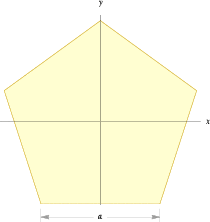
Determine a straightedge and compass construction of a regular pentagon. Start by playing with line and circle constructions and document your work. If after various attempts you cannot figure out a construction that can be justified then you may turn to other resources. Research Euclid’s methods and see if you can find something that you can reconstruct and understand. Discuss your explorations with your classmates by commenting on this post. You will present your explorations and your findings in class on Monday.




16 comments:
Hey, I was just wondering how everyone was doing on this. I was working on it today, and got a pentagon that was really close, but the sides were not exactly equal (I'm hoping it was a drawing error).
I'm not sure how much we are allowed to discuss about this... My pentagon is formed from a ton of circles with the same radii, and is pretty complicated, so I think there must be a simpler solution...
Well, in this case it would be good if you shared some details of how your construction works. When you say a ton of circles, how many do you really mean?
I've kind of been doing what Scott did, but I don't think I'm quite close at all; next I'm going to maybe try something with a square and adding on? Any thoughts on that?
Wow, I really don't know what I was thinking; completely disregard my last comment; using a square won't work at all. I must not have gotten enough sleep last night xD;;
I abandonned the multiple circle method and started working with other stuff; I ended up working through a hexagon, octagon, and a square, multiple triangles; I combined them into a circle but it got so cluttered I can't tell if any of my intersections of lines and arcs produce a regular pentagon. Pleeaasse. Anyone have any suggestions? I'm reworking with bisectors to see if I overlooked something.
I got it! After failing to create it, I figured that I needed a different approach (thinking outside the box), so I thought about the properties of a pentagon and realized that the goal is basically to connect them. This is the same as with a hexagon, but the sections must be larger.
I began by creating an equal lateral triangle, then I found the center of the triangle, similarly to creating the hexagon from the triangle on the worksheet. My construction includes 6 circles (3 of a large radius, 3 more of a smaller radius) and 5 lines plus the triangle that aren't part of the pentagon. It's hard to explain without seeing the it because I'm not exactly sure why it works, but it does.
Thank you sooooo much, Scott. I went back to the equallateral triangle and did the bisector thing to find the middle and after I played around with circles of different radii for ...maybe 10-30 minutes, I finally found four points that looked good, and I found the fifth in the middle of a bisector and a circle so I connected them; when I checked the radius with the compass, they all matched up, so I think I got it! Thanks again, Scott =D
I like the line of communication so far folks. Yet, I would urge both Scott and Whitney to be able to prove to themselves whether all the sides of their apparent pentagon have equal length. Remember, looking equal is not the same as being equal.
Also, it would be a good idea to go online and look for constructions of the pentagon. There are many websites that have it and you can compare your methods with those. Euclid's methods are online too. In fact, it wouldn't be a bad idea to try one of them for yourself.
As for checking the length, I went from the five points with my compass and they hit dead on, any slight error I would hope to be a drawing error.
I'm looking at some different methods now and one for inscribing a pentagon within a circle seems quite different from what we did. I'm following it until it gets to the two points at the bottom. Either it doesn't say how to get there or I'm just missing something, which is entirely possible. http://www.cut-the-knot.org/pythagoras/pentagon.shtml
i spent a long time trying different ways to draw the regular pentagon, and none of them worked so i looked online at a few websites and this one really helped.
www.nationmaster.com/encylopedia/pentagon
thankyou amanda i am not sure i would have gotten it without that site
Thanks alot Amanda. That site was great and it worked perfectly. Probably would not have gotten it without that.
I was watching a show on the history channel about ancient greek math cults, and I got my idea on how to make a pentagon from the ancient greeks. The pentagon contains a 5-pointed star inside. I was able to start with a line segment and since the 5 lines in the star must be equal, I was able to construct pentagon around the star that was formed through the intersections of circles.
Below is the website that I used to make a pentagon.
http://sierra.nmsu.edu/morandi/CourseMaterials/ConstructingAPentagon.html
Hey class i figured out another theory on solving it, although I'm sure someone else has thought of it before...Or maybe I may have just inversed the original design. Anyway just posting to say hi...
Post a Comment