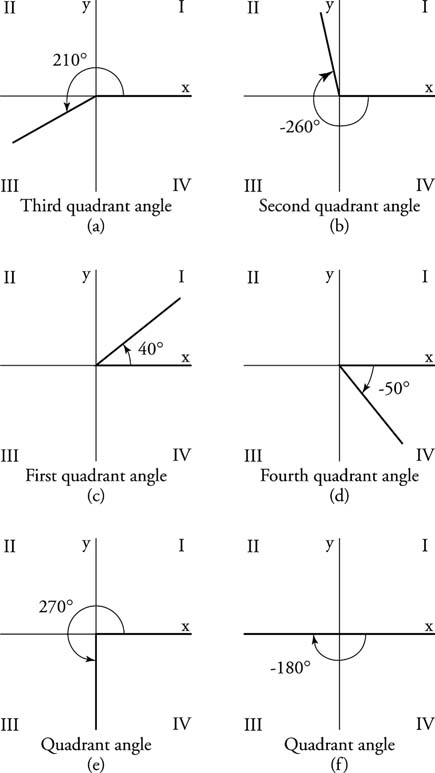
Folks, your assignment for Friday is the handout I gave you in class. If you misplace it or forget it in school you should download it from the AGT conference folder in First Class. If some of you felt overwhelmed by today's class then I suggest looking over the notes and the whole deal with radian measure, degree measure, negative angles and what they mean and what we mean by angles larger than 360 degrees or 2Pi radians. Click here for an image that can help you with the questions about quadrants.
Below are some things to remember for the homework assignment:
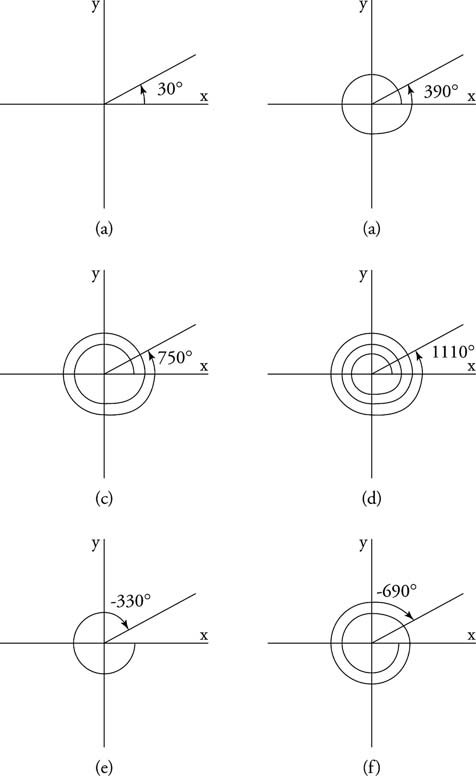
In question 1 you should refer to your unit circles and/or your trig tables. Remember that the sign (- or +) for sines, cosines and tangents becomes very important here. If angles are negative, then figure out which positive angles they are "co-terminal" with to figure out the sines, cosines and tangents. If the angles are larger then 360 degrees or much smaller than 360 degrees (such as - 405 degrees) then do the same, i.e. figure out which angle it is co-terminal with and then find the corresponding function values from your unit circle. Below is a link to an image that I think will help you understand what is meant by these new types of angles we are witnessing:
http://media.wiley.com/Lux/65/10665.nfg003.jpg
In question 2 you should note that I have asked for two solutions to the equations. In other words, there are two angles between 0 and 360 degrees that correspond to those particular lengths of lines that each equation depicts. Look at your unit circles and this will make more sense. Make sure to give the angles in both radians and degrees as the question demands. Remember, no calculators here as well.
Question 3 should be a straightforward question that you need no special hints for.

Subscribe to:
Post Comments (Atom)


10 comments:
One quick question, For number 1d, is -405 the same as 45 or 315? I am thinking 315, because it is a negative angle, but I am not sure.
315 is the angle that is coterminal with -405 degrees and 45 degrees is the reference angle. So you could also say that -405 is coterminal with -45 degrees. Make sense? Do look at the images I put links to in the post. They are pretty cool.
Yes thank you. I did look at the images and they were cool looking.
Can anyone help me get started on the sheet for Monday. The one that says to the moon and back. I have have tried looking at different angles, but am getting nowhere. Any suggestions?
Something to note on the moon distance assignment is that BC is tangent to the circle representing the earth. Since any observer will measure an based on his/her horizon line, which is BC in this case for the observer at B.
Also, I have uploaded the answers to the first worksheet that was homework due friday. Check the conference folder.
Another hint for the Moon problem is that you can know what angle beta is because you now the arc length of arc BE (300 Km). I have already provided you with a radius of the earth in kilometers. Find the circumference and see what ratio 300 is out of the whole circumference. That should be the same ratio as that of the angle beta to 360 degrees.
Oh and please don't forget, the diagram is really not to scale!!!!
on the moon problem, i found the ratio you suggested, so i think i found beta. then i think i found the sine of beta, but im not sure if you need that or not. then, i got stuck. can anyone help me?
Well, I did tell you that BC was a tangent line. So what are the right triangles you know of on the diagram?
The sine of beta will be important because you can think of ratios of lengths that equal sine of beta. Setup as many proportions as you can and you will see a system of equations that will be useful. Remember that CE plus DC is the distance to the moon.
Post a Comment